
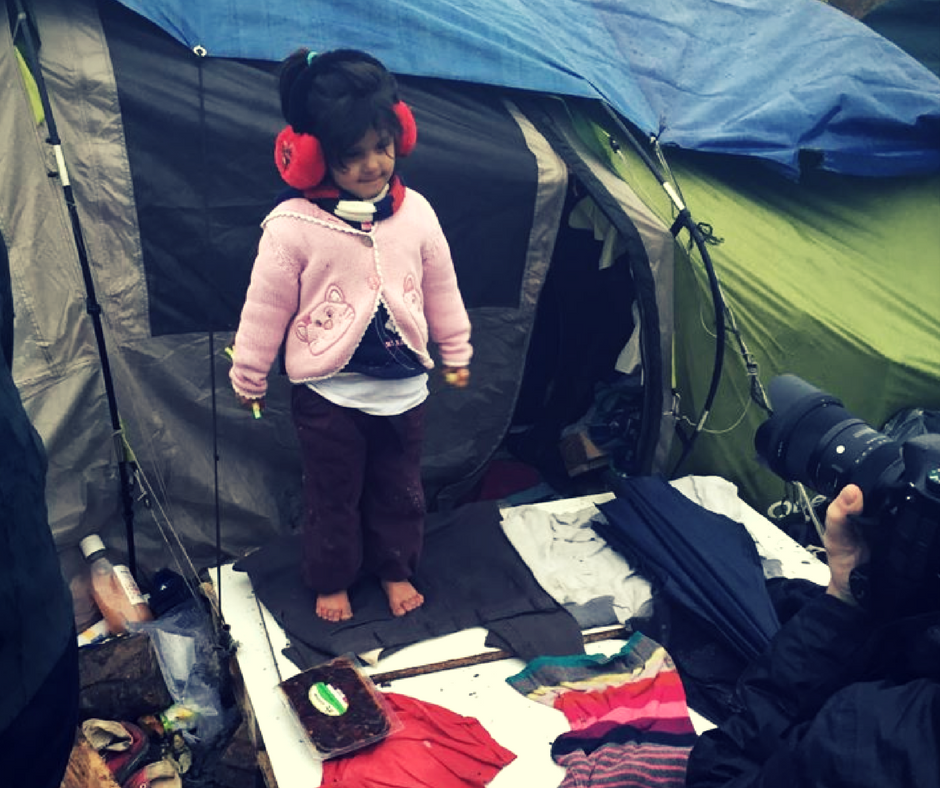

Late 2015. In a French refugee camp. You see tents everywhere. Little igloos and triangles scattered in the bushes. Waste everywhere. I sink ankle-deep into the grey slurry mud. It smells badly. They have no restrooms. It’s almost freezing temperatures. It has been raining for days. Everything is damp and wet.
I see a blue/green tent with an EPAL pallet in front of it. A little girl is standing barefoot on the pallet. She cannot be older than four. Two men are cooking fish in oil on a small camping gas stove. They wave at me, and I briefly lock eyes with them. A whole world becomes visible through their eyes, transferred into my being through their genuine smiles.
I go around the camp — hundreds of tents, deep grey slurry mud, little fires, smoke, and strong smells everywhere — and listen to their stories, weep with them, hug the mothers with their layers of damp clothes, “Salam aleikum” and “shokran”, while they share the “nothing” that they have with me without hesitation. They don’t accept my “no.” And then I need to go home, after promising a bunch of young guys with bewildered eyes to come back tomorrow and bring walking shoes, for they get stolen by the riot police.
At the entrance of the camp, two riot police men in full armor are witnessing the scene. They check IDs and argue with British volunteers about who gets to enter, and where they need to be (not here). They look like stone pillars overseeing the impossible scene, untouched by it on the outside.
A few volunteers are discussing strategy for building restrooms: what material they’re gonna use and where to get it, drawing sketches on a piece of paper. I walk past them and think: if they would only allow themselves to see and feel what I see and feel. Then they would be in the mud with me, crying, listening, sitting by the little gas stove fires, feet getting cold, clothes getting wet, and still eating the meal they got served from the little canned food ration, carefully stored underneath a blanket in a damp tent, saying “shokran” from one heart to another.
Volunteering is the “love language.” It needs analysis, understanding, and assessment of the weight of the situation. We help each other; everyone has their unique talent. We just need to find out how to bring it all together and work in a cohesive way for the benefit of as many people as possible. We mostly fail. Power struggles and clashing egos.
Two women, who just met, putting up a heavy cotton tent with sticks we can find. For H., still so young, traveling with his nephew. A. and I manage — I just met her 2 minutes ago; she’s Irish — and H. invites us for tea after taking a picture with us as proof of our tent building.
Delicious dark black tea with a ton of sugar — their “love language.” H. becomes a lifelong friend — for two weeks I sat in agony when he “disappeared” with his nephew. They made it to “the other side” in a lorry one night — thank God. He’s now built a life there and has a family of his own.
But setting up tents is the comfort zone. That’s the detachment necessary, the lens to be able to zoom out and see the bigger picture, in order to come to a deeper understanding of what the situation needs, without collapsing into it emotionally.
There you will find most volunteers. They thrive on their talents to build and plan, helping out in a way that is visibly evident in the camp. They keep themselves busy that way. A community kitchen, a school, a distribution center for food and clothes. A charging station for mobile phones, becoming a cultural meeting place. More black tea — I will be awake for the next 48 hours.
But I feel utterly alone amongst volunteers. I’m filled with images and stories, with smells, touch, feelings, and the visceral experience of slurry mud sucking at my boots. No one meets me there, but the very people I serve. Because they have no choice.
I see the desperation in their eyes; an internal barrel on the verge of overflowing again, but hardly anyone to pour into. I see and feel all of it. I collect their stories. I write about it. My compassionate nature hidden behind a freelance presscard; my entry into the camp and past the French stone pillars. I’m giving all of them a name and a face. I feel the emotions all over again when I write.
And yet, this is exactly where I need to be. I have not experienced more human intimacy than here, in the mud, not seemingly doing anything. And yet, doing so, so much.
There’s a time for analysis and planning, for building and being focused on the task. But it’s not necessarily what they need. It’s what we think they need. They have always found a way to get what they need and survive. Most of them just want to be met and feel human again, but everyone is running around “managing” everything instead.
And then comes that moment I will have to leave and go home. Driving a comfortable car, taking a hot shower, and crawling into a dry, soft, and warm bed. My mind resists leaving, but the body does it anyway. That’s what bodies do. They know how to move through experiences. I trust that.
For I’m the “wild one” that refused to be controlled, holding space for the depth of it all, including the hidden parts that no one sees.
—
I think about this often — the two riot police standing like stone pillars, untouched. The volunteers sketching restroom plans a few meters from a child standing barefoot on a wooden pallet. Not because they didn’t care. Because caring fully is unbearable. Managing is a way to survive it.
We do this everywhere, not just in refugee camps. We do it with our own grief, our own families, the people across from us at dinner who are trying to tell us something true. We retreat into planning, fixing, explaining, analyzing, because it’s safer than staying in the mud of what’s actually in front of us.
Understanding a situation is not the same as being touched by it. You can map a person’s pain perfectly and never once let it reach you.
There is a place for the mind. For strategy, structure, distance — the zoomed-out view that lets us build something useful. That work matters. But it cannot replace the other thing: the willingness to sit by the small fire with someone, feet going cold, and simply stay. To let another person’s reality land in your body before your mind gets to file it away.
Presence isn’t a technique. It’s a risk. It means staying past the point where retreating into thought would be easier — long enough to actually be moved, not just to have observed.
So, here’s what I keep coming back to, and what I’d offer to anyone reading this: the next time you feel yourself pulling back — into your head, into the plan, into the comfortable distance of watching rather than feeling — ask what it would mean to stay a little longer. To let yourself be in the mud with someone, fully, before you try to solve anything.
That’s where people actually meet each other.
Not in the analysis. In the staying.

0 Comments